
Good HR documentation protects your business, improves employee experiences, reduces administrative hassles, and helps your team confidently continue their work. When important records are missing or scattered across emails, spreadsheets, and filing cabinets, even routine HR tasks can become time consuming and stressful.
If you are building or growing a business in the UAE, maintaining the right HR documents UAE employers need should be one of your top operational priorities. Be it recruitment, payroll or performance management, every stage of the employee lifecycle relies on accurate documentation.
Our guide discusses the essential HR records every employer should maintain, the mistakes you should avoid, and the best practices for managing documents securely in a digital workplace.
Why Proper HR Documentation Is Essential?
HR documentation is the foundation of your workforce management strategy. That’s why every hiring decision, salary update, performance discussion, and leave request creates information which should be properly documented and stored.
Well organized documentation is essential for your company for the following reasons:
- Maintain consistency across HR processes.
- Improve communication between HR, managers, and employees.
- Reduce administrative delays.
- Support payroll accuracy.
- Keep employee information secure.
- Simplify audits and internal reviews.
- Build trust through transparent HR practices.
Without proper documentation, businesses end up spending unnecessary time searching for records, correcting errors, or recreating missing information. As your workforce grows, those small inefficiencies quickly become expensive operational challenges.

Essential HR Documents Every UAE Employer Should Maintain:
Every employee file should contain a structured set of documents that remains updated throughout their employment. Following are the most important records every employer should maintain:
1. Offer Letter:
The hiring process officially begins with the offer letter. An offer letter outlines the proposed role, salary, reporting structure, start date, benefits, and other employment terms before your employee joins the company. It makes sure that both parties share the same expectations before moving forward.
A well drafted offer letter prevents misunderstandings and creates a smooth transition from recruitment to onboarding at the same time.
2. Employment Contract:
After the offer is accepted, the employment contract becomes one of the most important documents in your employee’s file. The contract clearly defines employment terms, responsibilities, compensation, working hours, notice periods, and other agreed conditions.
You can make certain that there is always a reliable reference whenever employment terms need clarification by managing signed copies. Moreover, you should always securely back up your digital copies alongside physical records where required.
3. Job Description:
A lot of companies create job descriptions during recruitment but rarely update them afterward. A current job description provides clarity about the following:
- Employee responsibilities.
- Reporting relationships.
- Performance expectations.
- Required skills.
- Department objectives.
Updated job descriptions make recruitment easier, improve onboarding, support performance evaluations, and help managers assign responsibilities consistently.
4. Passport Copies:
Maintaining updated passport copies for every employee is a standard HR practice. Whenever an employee renews their passport, your HR team should replace outdated copies with the latest version to keep your employees’ records current. Digital document management systems make updating identification documents much faster than maintaining physical files alone.
5. Visa Copies:
Employee visa copies are another important part of personnel records. Your HR team should keep updated visa documentation to maintain accurate employee profiles and easily retrieve records whenever administrative verification is required. Your business should establish regular review schedules to make certain that expired copies are being promptly replaced.
6. Emirates ID Copies:
The Emirates ID is an important identification document for employees working in the UAE. Your HR department should securely maintain copies alongside other identification documents. Meanwhile, it should also be made sure that only authorized personnel can access sensitive employee information.
Whenever employees renew their Emirates ID, HR records should be updated immediately.
7. Medical Insurance Documentation:
Medical insurance information is a necessary part of your employee files. As an employer, you should maintain records of the following:
- Insurance policy information
- Coverage details
- Membership information
- Renewal dates
Having this information readily available simplifies employee support whenever healthcare documentation is needed.
8. Payroll Records:
Payroll documentation is among the most frequently accessed HR records. Accurate payroll records include the following information:
- Salary details
- Allowances
- Deductions
- Bonus records
- Salary revisions
- Payment history
Maintaining organized payroll records has a huge role in HR and finance teams working together more efficiently and reducing payroll errors. Moreover, digital payroll systems also make historical records significantly easier to retrieve.
9. Leave Records:
Employee leave management becomes increasingly complicated as organizations grow. Your HR team can track the following details by maintaining accurate leave records:
- Annual leave
- Sick leave
- Emergency leave
- Approved requests
- Leave balances
- Return to work dates
Well maintained leave records reduce scheduling conflicts and assists your managers to plan workloads more effectively. Employees also appreciate having visibility into their available leave balances.
10. Performance Reviews:
Performance reviews create valuable documentation throughout an employee’s career. Consistent documentation creates fairness across teams and supports future career planning.
Instead of relying solely on informal conversations, organizations should maintain written records of the following:
- Performance evaluations
- Goal setting discussions
- Development plans
- Promotion recommendations
- Training outcomes
- Manager feedback
11. Employee Warnings and Disciplinary Records:
Performance concerns and workplace issues should always be documented professionally. Accurate records provide clear historical context while encouraging consistent management practices across departments.
Documentation should always remain factual, objective, and securely stored. Your employees’ files should include written warnings, counseling records, improvement plans, and documented follow-up discussions.

Building a Well Organized Employee File:
Having everything stored in one centralized location makes HR administration is significantly more efficient. That’s why a complete employee file should include the following details:
- Offer letter.
- Employment contract.
- Job description.
- Passport copy.
- Visa copy.
- Emirates ID copy.
- Medical insurance documents.
- Payroll records.
- Leave records.
- Performance reviews.
- Warnings or disciplinary records.
- Updated personal information whenever any changes occur.
Common Documentation Mistakes Businesses Make:
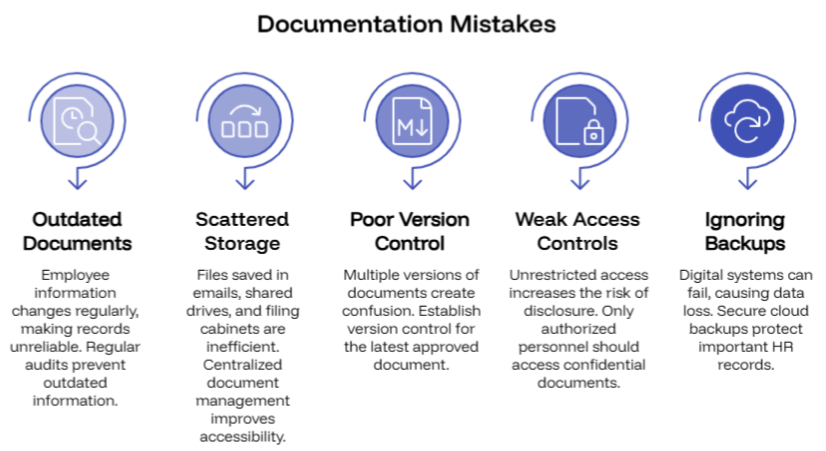
Most businesses understand the importance of documentation but still struggle with maintaining accurate records. The most common issues they are faced with include not updated documents, records being stored across several locations instead of one centralized platform, ignoring backup procedures, and not having proper access for authorized use.
Not Updating Documents:
Employee information changes regularly, as passports expire, Emirates IDs are renewed, salaries change, departments evolve, and insurance policies are updated. When records are not refreshed, employee files quickly become unreliable. Regular audits prevent outdated information from accumulating.
Storing Documents Across Multiple Locations:
Workflow for many businesses look like some files are saved in emails, others are stored on shared drives, and some remain inside filing cabinets. When documentation is spread across multiple systems, finding the right record becomes frustrating and inefficient.
You can overcome this challenge by integrating centralized document management which in turn improves accessibility.
Poor Version Control:
Multiple versions of the same employment contract or job description creates confusion, which is why businesses should establish clear version control practices so employees and managers always reference the latest approved document.
Weak Access Controls:
Employee records contain sensitive personal information. Allowing unrestricted access increases the risk of accidental disclosure or unauthorized viewing. Only authorized HR personnel should have access to confidential employee documents.
Ignoring Backup Procedures:
Digital systems can fail, computers can be damaged, and files can be accidentally deleted. With secure cloud backups and routine backup schedules, you can make it certain that your important HR records remain protected.
Digital HR Documentation Best Practices:
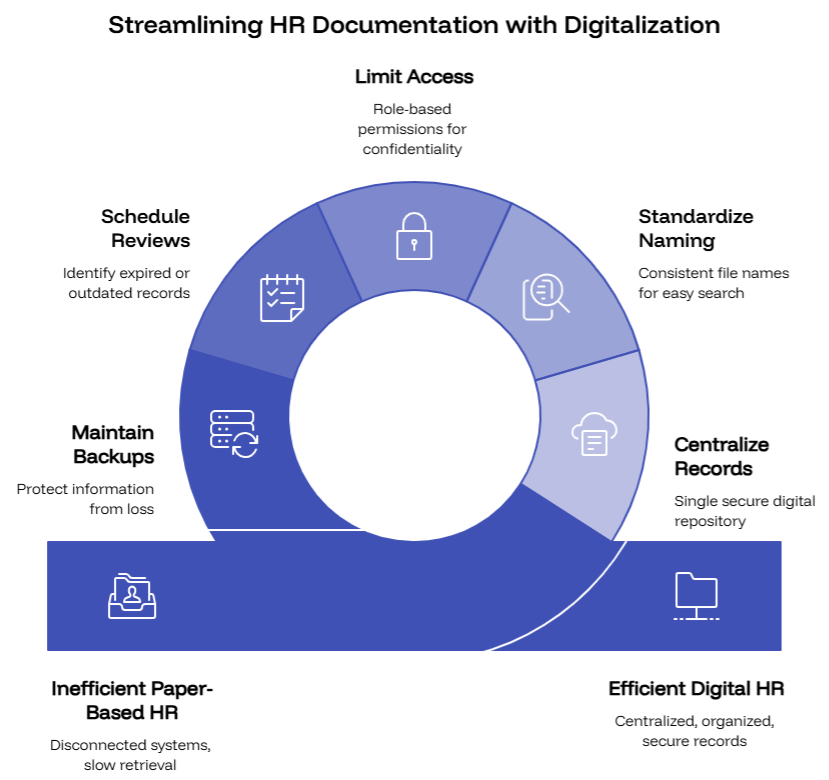
Modern HR departments are increasingly moving away from paper-based filing systems. Digitizing employee records improves efficiency and makes documentation easier to maintain over time.
Some best practices include centralizing all employee records, organizing your files using standard format, limiting access based on roles, scheduling regular document reviews, and maintaining secure backups:
Centralize All Employee Records:
You should store every employee document within one secure digital repository instead of using multiple disconnected systems. With centralization, you can reduce duplication and speed up document retrieval.
Organize Files Using Standard Naming Conventions:
Consistent file names make searching significantly easier. For example, using employee names alongside document types and dates enables your HR teams to locate files within seconds.
Limit Access Based on Roles:
Not every manager needs access to every employee document. Role-based permissions maintain confidentiality and ensure the right people have access when needed.
Schedule Regular Document Reviews:
You should schedule quarterly or annual reviews at your organization to identify expired documents, missing information, or outdated records before they create operational issues.
Maintain Secure Backups:
Reliable backup systems protect valuable HR information from accidental loss, hardware failures, or unexpected technical issues. Automatic backups reduce manual work and improve business continuity.
How Connect Group Simplifies HR Documentation?
Managing employee documentation becomes more challenging as your business expands. Having more employees on board means more contracts, identification documents, payroll records, performance reviews, and ongoing updates to handle.
At Connect Group, we help businesses digitize and organize their employee records through secure document management solutions. So instead of relying on scattered spreadsheets, email attachments, or physical filing cabinets, your business can maintain centralized employee files which are easier to access, update, and manage.
A digital approach also improves collaboration between HR and management and reduces administrative workloads. With organized document storage, secure access controls, and simplified record management, your HR teams spend less time searching for files and more time supporting your employees and business growth.

Invest in Secure Digital Document Management:
Strong HR processes begin with strong documentation. Every offer letter, employment contract, payroll record, leave request, performance review, and identification document contributes to a complete employee record that supports efficient business operations.
Maintaining accurate HR documents which every UAE employer needs not only improves productivity, but strengthens internal processes, protects sensitive employee information, and helps HR teams operate with greater reliance.
As your workforce grows, investing in secure digital document management becomes one of the smartest ways to build an efficient and scalable HR function that is ready for the future. Contact us now for our services.