Missing one HR deadline can cause a chain reaction that affects payroll, employee satisfaction, business continuity, and regulatory compliance for your company. That’s why successful businesses manage compliance not only when something expires but follow a structured process to keep every obligation on track throughout the year.
If your business manages multiple employees, visas, payroll cycles, and benefits, treating compliance as an ongoing activity instead of an annual checklist will save you time, money, and unnecessary stress. We have created this HR compliance calendar UAE guide to provide businesses with a practical month-by-month framework to manage recurring HR responsibilities without scrambling at the last minute.
Our calendar will help you stay organized, reduce compliance risks, and create smoother HR operations for running your startups, SMEs, or large enterprises.
What is an HR Compliance Calendar?
An HR compliance calendar is a structured schedule which maps recurring HR tasks, statutory obligations, and employee lifecycle activities across the year. Instead of relying on memory or scattered reminders, HR teams use a centralized calendar to ensure every requirement is completed before its deadline.
For UAE businesses, an effective HR compliance calendar includes the following tasks:
- Monthly payroll processing.
- WPS salary submissions.
- Employment visa renewals.
- Emirates ID tracking.
- Labour contract renewals.
- Medical insurance renewals.
- Annual leave reconciliation.
- Employee file updates.
- HR policy reviews.
- Internal compliance audits.
- Performance review cycles.
- Training and onboarding schedules.
Instead of viewing compliance as a legal burden, businesses should see it as an operational advantage, as organized HR processes reduce delays, improve employee trust, and help companies remain audit ready throughout the year.

Why Every UAE Business Needs an HR Compliance Calendar?
Many compliance issues happen because deadlines are forgotten, not because companies intentionally ignore regulations. An HR compliance calendar helps your business with these benefits:
- Prevent missed visa and contract renewals.
- Maintain accurate employee records.
- Process payroll consistently through WPS.
- Improve HR planning across departments.
- Reduce administrative bottlenecks.
- Prepare for inspections and audits.
- Minimize costly last minute renewals.
It also gives your managers better visibility into upcoming responsibilities, so your HR, finance, and leadership teams co-ordinate more effectively.
Annual HR Compliance Calendar for UAE Businesses
Where every organization has unique requirements, most UAE employers share the same recurring HR responsibilities. The calendar below provides an evergreen format that can be adapted to businesses of all sizes.
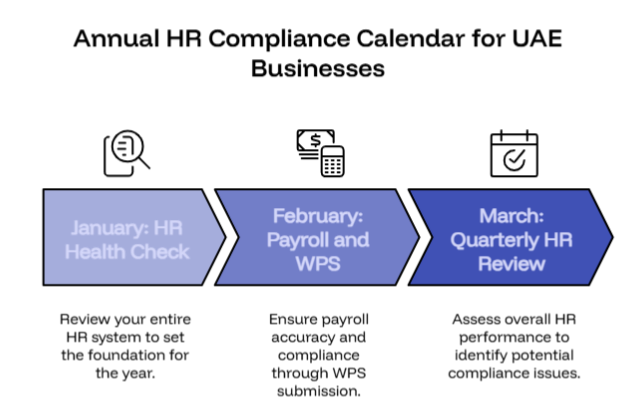
January: Start the Year with an HR Health Check
January is the ideal time to review your entire HR system as this month sets the foundation for the rest of the year. So you should focus on the following tasks:
- Review employee records for accuracy
- Update emergency contacts
- Verify visa and passport expiry dates
- Confirm insurance renewal schedules
- Review annual leave balances
- Refresh compliance trackers
- Update HR documentation whenever necessary
February: Payroll Accuracy and WPS Review
Consistent payroll accuracy reduces employee complaints and strengthens compliance. For payroll compliance, your major activities during February should include the following:
- Process monthly payroll
- Submit salaries through WPS
- Reconcile attendance records
- Review overtime calculations
- Verify employee salary records
- Resolve payroll discrepancies quickly
March: Quarterly HR Review
The end of the first quarter is a good opportunity to step back and assess overall HR performance. Quarterly reviews help identify problems before they become larger compliance issues. That’s why your HR teams should review these areas during March:
- Recruitment documentation
- Employee onboarding files
- Probation tracking
- Compliance documentation
- HR policy effectiveness
- Upcoming visa renewals
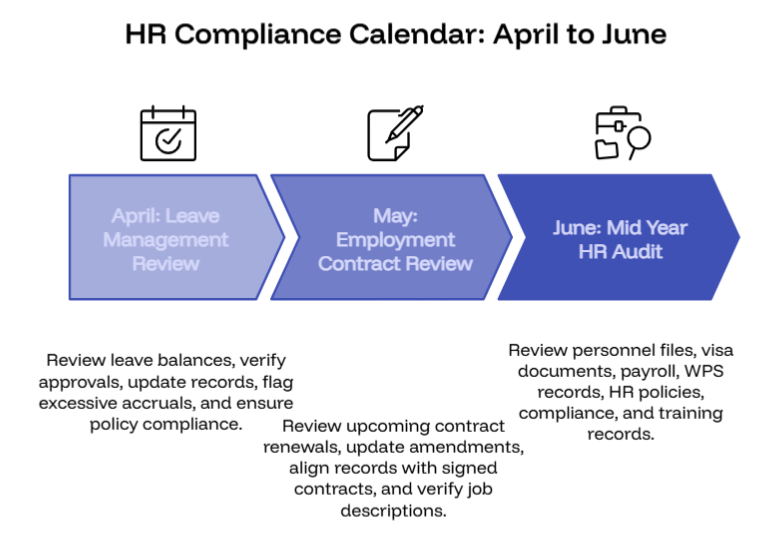
April: Leave Management Review
A lot of businesses overlook leave reconciliation until year end. Good leave management improves workforce planning and employee satisfaction. April is an excellent time for your teams to:
- Review annual leave balances
- Verify leave approvals
- Update leave records
- Identify employees with excessive leave accumulation
- Ensure leave policies remain consistent
May: Employment Contract Review
Employment contracts should always remain current and aligned with business requirements. Keeping contracts updated reduces administrative issues later in the year. Your HR teams should perform the following functions:
- Identify upcoming contract renewals
- Review contract terms
- Update amendments where necessary
- Ensure employee records match signed contracts
- Confirm job descriptions remain accurate
June: Mid Year HR Audit
The halfway point of the year provides the perfect opportunity for a comprehensive HR audit. Since internal audits can help you uncover missing documents before official inspections do, evaluate the following:
- Employee personnel files
- Visa documentation
- Payroll records
- WPS submissions
- Compliance documentation
- HR policies
- Training records
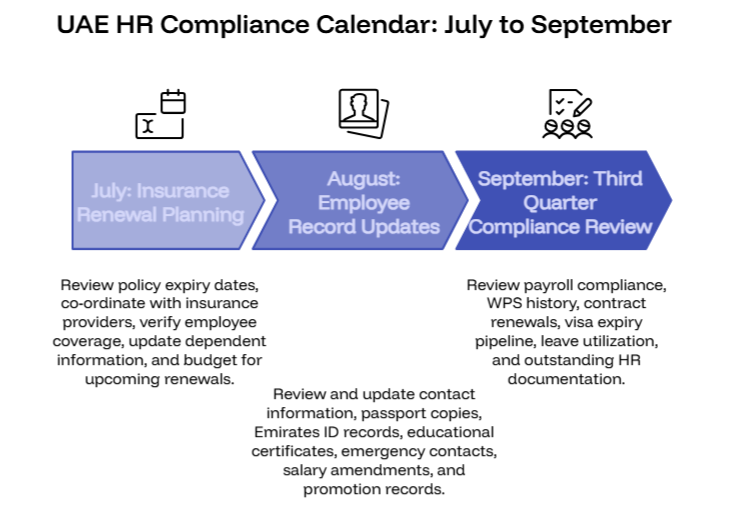
July: Insurance Renewal Planning
Medical insurance is an important part of employee compliance in the UAE and starting early prevents coverage gaps. Your HR teams should:
- Review policy expiry dates
- Co-ordinate with insurance providers
- Verify employee coverage
- Update dependent information
- Budget for upcoming renewals
August: Employee Record Updates
Employee information changes throughout the year. Accurate employee records support smoother HR operations and legal compliance, so you should review and update the following:
- Contact information
- Passport copies
- Emirates ID records
- Educational certificates
- Emergency contacts
- Salary amendments
- Promotion records
September: Third Quarter Compliance Review
The third quarter is another important checkpoint before year end. At this time, your teams should review the following as it gives you sufficient time to resolve issues before year-end:
- Payroll compliance
- WPS history
- Contract renewals
- Visa expiry pipeline
- Leave utilization
- Outstanding HR documentation
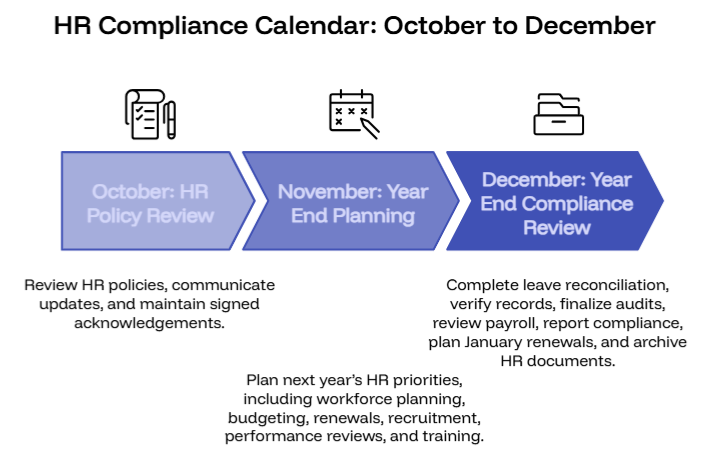
October: HR Policy Review
Businesses expand and update, and HR policies should reflect that. That’s why you should review your company’s policies covering:
- Attendance
- Remote work
- Leave
- Disciplinary procedures
- Code of conduct
- Employee benefits
- Workplace health and safety
Moreover, you should communicate any updates clearly to your employees and maintain signed acknowledgements wherever it’s required.
November: Year End Planning
November is perfect for preparing next year's HR priorities. Planning ahead prevents compliance work from piling up in December. Your teams should focus on the following during this month:
- Workforce planning
- Budget forecasting
- Renewal scheduling
- Upcoming recruitment
- Employee performance review preparation
- Training plans
December: Year End Compliance Review
December should focus on closing the year with complete and accurate documentation. A thorough year end review creates a smoother transition into the following year. This is the time for your teams to complete:
- Final leave reconciliation
- Employee record verification
- HR audit completion
- Payroll review
- Compliance reporting
- Renewal planning for January
- Archive completed HR documentation
Monthly Compliance Activities that Never Stop
Some HR responsibilities occur every single month regardless of the calendar.
Payroll Processing
Payroll must be processed accurately and on time every month. Salary calculations should reflect attendance, overtime, deductions, leave, and approved allowances as consistent payroll builds employee trust and supports compliance requirements.
WPS Salary Submission
Salary payments should be processed through the Wage Protection System (WPS). Regular monitoring helps you identify payment issues before they become compliance concerns.
Visa Renewals
Employee visas should be monitored continuously throughout the year. Instead of waiting on visas until expiry, you should maintain a rolling renewal schedule with reminders well ahead in advance.
Contract Renewals
Employment contracts should be reviewed before expiration to avoid administrative delays and employment interruptions. You can simplify this process by maintaining a renewal tracker.
Employee Record Updates
HR records should remain current at all times. Whenever employees experience changes in personal information, compensation, job title, or documentation, you should have the records updated immediately.
Quarterly HR Reviews That Keep Businesses Audit Ready
Monthly activities are necessary for maintaining day-to-day compliance but quarterly reviews are important to provide a broader perspective. Quarterly reviews make annual audits significantly easier because documentation remains current throughout the year. A quarterly HR review should examine payroll compliance, recruitment documentation, HR policy compliance, workforce documentation, and training compliance.
Payroll Compliance
You should verify payroll calculations, WPS submissions, and employee compensation records.
Recruitment Documentation
HR teams should make certain that the hiring documentation remains complete for every employee.
HR Policy Compliance
Your business should quarterly review if your managers and employees are consistently following internal policies.
Workforce Documentation
Your HR teams should confirm that the personnel files remain complete with updated identification documents, contracts, and approvals.
Training Compliance
You should review mandatory training completion and identify any upcoming requirements.

Common Deadlines Businesses Miss
A lot of compliance problems stem from routine administrative oversights and not complex legal issues. Some of the most commonly missed deadlines are for visa expiry dates, labour contract renewals, medical insurance renewals, leave reconciliation, employee record updates, and HR policy reviews.
Visa Expiry Dates
Missing renewal windows can interrupt your employee’s work authorization and create avoidable administrative complications for your business.
Labour Contract Renewals
Delayed contract updates can lead to documentation inconsistencies and unnecessary processing delays.
Medical Insurance Renewals
Expired employee coverage creates operational risks and employee dissatisfaction.
Leave Reconciliation
Ignoring leave balances throughout the year makes year end reconciliation more complicated.
Employee Record Updates
Outdated contact details, expired identification documents, and incomplete personnel files frequently appear during compliance reviews.
HR Policy Reviews
Policies that have not been reviewed for several years might no longer reflect your current business operations or regulatory expectations. The simplest solution is diligent tracking instead of reactive corrections.

Best Practices for Maintaining an Effective HR Compliance Calendar
Creating a calendar is only the beginning; the real value comes from consistently following it.
Successful businesses implement the following strategies to create a repeatable compliance process:
- Use automated reminders for recurring deadlines
- Maintain centralized employee records
- Conduct quarterly internal audits
- Review compliance responsibilities during management meetings
- Coordinate HR and finance activities
- Assign clear ownership for every recurring task
- Keep digital copies of all employee documentation
- Update the calendar whenever regulations or business processes change
How Connect Group Helps You Stay Ahead of Compliance
Managing HR compliance becomes more complicated as businesses grow. Multiple renewal dates, payroll cycles, employee documentation, insurance policies, and legal requirements can quickly overwhelm your internal teams.
At Connect Group, we help businesses simplify HR administration through structured compliance support so everything stays organized throughout the employee lifecycle. Our HR specialists assist businesses with:
- Payroll processing and WPS management
- Employment visa support
- Labour contract administration
- Employee onboarding documentation
- HR compliance monitoring
- Record management
- Ongoing HR advisory services
Your HR team can focus on supporting employees and contributing to your business’s growth. Meanwhile our experienced professionals keep compliance activities on schedule for you.

Keep Things on Track with HR Compliance Calendar
Be it payroll, WPS submissions to visa renewals, insurance tracking, contract management, leave reconciliation, policy reviews, HR audits, or employee record updates, every task becomes easier when scheduled throughout the year instead of being left until the last minute. That’s why an effective HR compliance calendar UAE is a great resource for businesses to manage these recurring obligations with full confidence, consistency, and efficiency.
Following a structured annual compliance calendar reduces risk, improves operational efficiency, and creates a more reliable HR function to support your long-term business success.
Frequently Asked Questions
An HR compliance calendar is a structured schedule that maps recurring HR tasks, statutory obligations, and employee lifecycle activities across the year, so nothing is missed or left to memory.
Recurring monthly tasks include payroll processing, WPS salary submissions, visa monitoring, contract renewal tracking, and keeping employee records up to date.
Businesses most often miss visa expiry dates, labour contract renewals, medical insurance renewals, leave reconciliation, employee record updates, and periodic HR policy reviews.
A quarterly review cycle, with a more comprehensive mid-year and year-end audit, keeps documentation current and makes annual compliance checks far easier.
Yes. Connect Group's HR specialists handle payroll and WPS management, visa support, contract administration, onboarding documentation, and ongoing compliance monitoring for UAE businesses.