What is the GCC Region?
The Gulf Cooperation Council is a regional economic and political alliance comprising six (6) countries:- United Arab Emirates
- Saudi Arabia
- Qatar
- Bahrain
- Kuwait
- Oman

What is an Employer of Record (EOR)?
An Employer of Record is a third party organisation that legally employs workers on behalf of another company. While the EOR becomes the employee’s legal employer for compliance purposes, your business retains complete control over daily responsibilities, performance management, projects, and company culture. An EOR manages the legal and administrative aspects of employment, including:- Locally compliant employment contracts
- Payroll processing
- Visa sponsorship and work permits
- Statutory benefits administration
- Employee onboarding and offboarding
- Labour law compliance
- Employment termination support
- Background checks where applicable
- day to day work
- employee performance
- projects
- promotions
- compensation decisions
- company culture
- termination decisions
What Does an Employer of Record Do?
Your EOR manages the complete employment lifecycle for you. They handle:- compliant employment contracts.
- payroll processing.
- visa sponsorship.
- work permits.
- employee onboarding.
- employee offboarding.
- statutory benefits.
- HR administration.
- employment record keeping.
- labour law compliance.
- ongoing legal updates.

Why Businesses Choose an Employer of Record
Businesses choose an employer of record because it gets them the following outcomes:- entering GCC markets faster.
- reducing expansion costs.
- avoiding lengthy incorporation processes.
- testing new markets before committing.
- hiring specialised talent anywhere in the GCC.
- reducing HR administration.
- scaling teams up or down with less operational complexity.
- staying compliant as labour laws change.
Employer of Record vs PEO vs GEO: What’s the Difference?
Although the terms EOR (Employer of Record), PEO (Professional Employer Organization), and GEO (Global Employment Organization?) are sometimes used interchangeably, the 3 of them solve different business challenges.- PEO supports companies that already have a legal entity.
- EOR becomes the legal employer where no entity exists.
- GEO is a global workforce model that often coordinates multiple local EORs across different countries.
| Feature | Employer of Record | PEO | GEO |
| Legal employer | Yes | No | Usually delivered through an EOR model |
| Requires your own legal entity | No | Yes | Depends on provider |
| Payroll administration | Yes | Yes | Yes |
| Employment compliance | Full responsibility | Shared responsibility | Varies |
| Best suited for | International hiring without incorporation | Businesses with an existing entity | Global workforce management |

Who Benefits Most From an Employer of Record?
EOR services work particularly well for the following type of companies:- startups.
- SMEs.
- multinational companies.
- businesses entering GCC markets.
- remote first organisations.
- companies hiring specialised talent.
- project based hiring.
- organisations expanding before establishing permanent offices.
Should You Choose an EOR or a PEO?
The right solution depends on your expansion strategy rather than your company size.Do you already have a legal entity?
If your business already operates through a registered entity in the UAE or another GCC country, a PEO can manage HR administration on your behalf while you remain the legal employer. If you have not established a local entity, an Employer of Record is the faster and more practical option. It allows you to hire employees immediately without waiting for incorporation, banking approvals, licensing, and other administrative requirements.How quickly do you need to hire?
If you need employees within weeks, then you should choose EOR. But if you are planning long-term operations with your own office, then having an entity and PEO services can be more efficient.How many employees are you hiring?
If you are hiring one employee, then EOR is the right choice. And if you want a large permanent office, then entity plus PEO will become more cost effective in the long run.Are you hiring employees or contractors?
If you are going to hire employees, then you should choose an EOR. If you want independent contractors, then contractor management will be sufficient. Moreover, when you are deciding between whether you want employees or independent contractors as part of your workforce, there are a few factors you need to consider. These include the extent of flexibility you want with your staff’s hiring model (short-term, temporary, project based or full time hires) and schedule. Other things to take into account are your long term workforce planning, intellectual property protection, compliance obligations, employee benefits, and contractor misclassification risks.
How EOR Services Simplify Cross Border Employment Across the GCC
UAE’s WPS, Saudi labour law, and Qatar’s immigration, all of these have different requirements. If your business is trying to handle everything on its own, it can become difficult, time consuming, exhaust your resources, and affect your internal teams’ workload. Cross-border employment is made simpler and easier across the GCC by EOR services:Accelerate Hiring Without Setting Up a Local Entity
Establishing a company in a new country requires licensing, regulatory approvals, banking arrangements, tax registrations, and ongoing compliance. Depending on the jurisdiction, this process may take weeks or months. An Employer of Record removes that barrier by enabling businesses to hire immediately through its existing legal infrastructure. This allows organisations to enter GCC markets faster while delaying incorporation until expansion plans become more established.Simplify Employee Onboarding:
A positive onboarding experience sets employees up for long term success. An EOR prepares compliant employment contracts, coordinates required documentation, manages visa applications where applicable, and ensures every legal requirement is completed before the employee starts work. Beyond contracts, EORs help you with document collection, payroll setup, benefits enrolment, government registrations, and orientation support. Meanwhile, your internal managers remain focused on introducing employees to company culture, responsibilities, and performance expectations rather than administrative paperwork.Assist with Immigration and Visa Requirements:
Every GCC country maintains its own immigration processes, sponsorship requirements, and work permit procedures. Missing documentation or misunderstanding local regulations can delay hiring considerably. An experienced Employer of Record manages these processes from start to finish, helping businesses navigate changing immigration requirements while reducing compliance risks for both employers and employees.Maintain Compliance With Local Employment Laws:
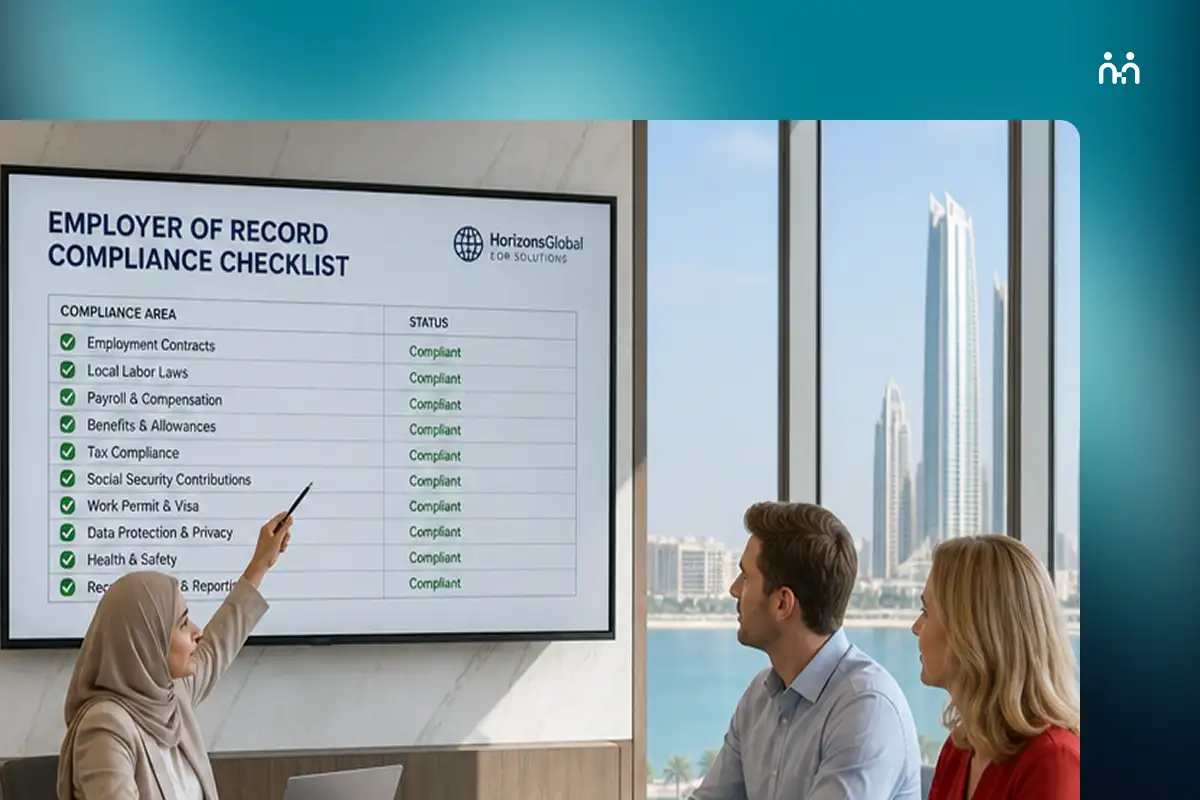
Employment legislation differs significantly across the GCC. Regulations covering probation periods, notice requirements, leave entitlements, termination procedures, and statutory benefits vary from one jurisdiction to another. For example, if your business is operating in the UAE, your EOR will assist you with MOHRE (Ministry of Human Resources and Emiratisation) requirements, WPS, free zone vs mainland, end of service gratuity, employment contracts, and visa sponsorship. When you partner with an EOR, your business gains ongoing access to local legal expertise that helps reduce the risk of disputes, penalties, and operational disruptions.
UAE Employment Responsibilities an Employer of Record Helps Manage:
An EOR manages compliance for the following employment responsibilities:- employment contracts.
- probation management.
- leave administration.
- end of service benefits.
- payroll obligations.
- Wage Protection System (WPS).
- health insurance requirements.
- overtime compliance.
- notice periods.
- employee records.
Manage Payroll and WPS Compliance:
Payroll is one of the most important compliance responsibilities when hiring across the GCC. Other than paying salaries accurately and on time, employers must comply with local payroll regulations, statutory deductions, employee benefits, and record keeping requirements. In the UAE, eligible private sector employers must process salary payments through the Wage Protection System (WPS), which enables authorities to monitor timely wage payments. Not meeting WPS obligations can result in administrative restrictions and other enforcement measures. An Employer of Record manages payroll processing, statutory calculations, compliant payslips, payroll reporting, and WPS administration. They handle statutory deductions compliant payslips, payroll reporting, government submissions, payroll audits, and tax documentation for you. This reduces administrative workload while helping ensure employees are paid accurately and in accordance with local regulations.Deliver Competitive Employee Benefits:
Employee expectations differ across GCC countries, and mandatory benefits often include health insurance, paid leave, end of service gratuity, and other statutory entitlements. An Employer of Record administers both mandatory and optional benefits, helping businesses remain compliant while delivering competitive employment packages that improve employee satisfaction and retention. While benefits are a compliance requirement, they are also great for a business’s retention strategy. With an EOR managing the benefit administration of health insurance, statutory benefits, gratuity, pension obligations, and leave management, you maintain compliance with the laws and keep your workforce happy at the same time.Local HR Expertise Matters More Than You Think:
Experienced EOR providers help businesses with labour market expectations, salary benchmarking, cultural awareness, hiring practices, onboarding support, and local HR customs.Bridge Cultural and Operational Differences:
Successful expansion requires more than legal compliance. Understanding workplace expectations, communication styles, public holidays, and local business customs helps international teams integrate more effectively. Many EOR providers support businesses with local HR guidance, helping organisations adapt policies and management practices to create a more productive and culturally aware workforce.What Should You Look for in a GCC Employer of Record?
Choosing the right partner can significantly influence both compliance and employee experience. Look for an EOR that offers established operations across GCC countries, has vast knowledge of local labour laws, comprehensive payroll expertise, visa and immigration support, transparent pricing, responsive HR specialists, and scalable services that continue supporting your business as your regional workforce grows. An Employer of Record should become your trusted partner that enables confident expansion into new markets while reducing legal and operational risk. We have a checklist that you can use as your evaluation criteria:- direct legal entities versus partner networks.
- GCC coverage.
- payroll accuracy.
- visa expertise.
- fast onboarding.
- compliance specialists.
- HR responsiveness.
- reporting technology.
- scalability as your workforce grows.
- employee support after hiring.
- WPS coverage.
- transparent pricing.
- assistance with Emiratisation, Saudization (Nitaqat system), Qatarization, Kuwaitization, Bahrainization, and Omanization programs.

When Should You Transition From an Employer of Record to Your Own Entity?
An EOR is often the best solution during market entry. But businesses sometimes want to eventually establish their own entity when they have larger employee numbers, permanent office locations, long term regional operations, licensing requirements, and significant ongoing investment. You too can make the switch to your own entity once you have all these things covered. There are businesses that use hybrid models which means they continue to use EOR services in new markets while operating directly in established ones.Is an Employer of Record the Right Choice for Your Business?
An Employer of Record is often the ideal solution if you’re testing a new GCC market, hiring remote employees across multiple countries, building a regional sales team, recruiting specialised talent, or expanding internationally without immediately establishing subsidiaries. Instead of singlehandedly working with multiple legal systems, your business can focus on growth while experienced employment specialists manage compliance, payroll, and workforce administration behind the scenes.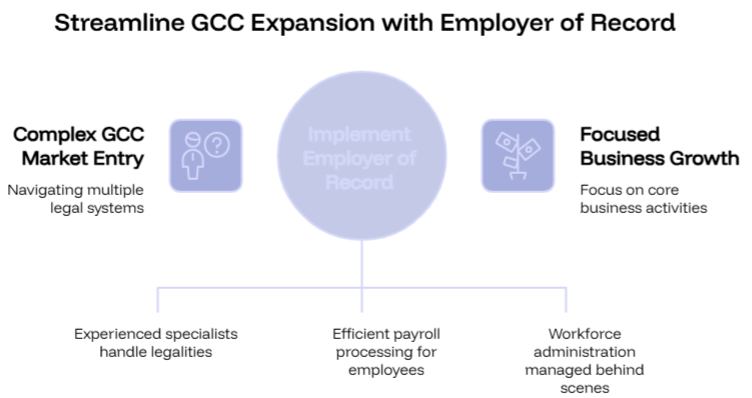
Expand Across the GCC With Connect Group
Growing across the GCC creates exciting opportunities. But successful expansion depends on getting employment compliance right from day one. An experienced Employer of Record enables your business to hire faster, simplify payroll, fulfill immigration requirements, and maintain compliance across every stage of the employee lifecycle. At Connect Group, we help businesses expand across the GCC with comprehensive Employer of Record solutions tailored to regional employment regulations. Our local experts handle the details for hiring, so your team can focus on growing the business with confidence. Contact us now.